
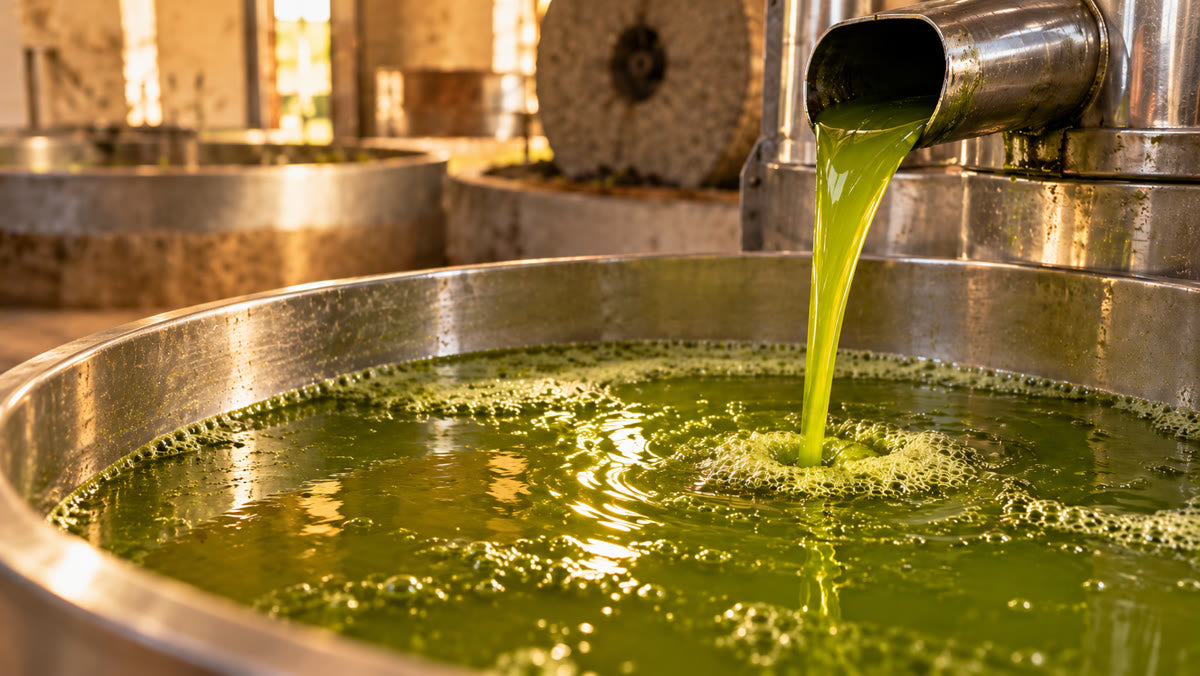
Early harvest olive oil is an extra virgin olive oil made from olives picked at the very start of the season, while they're still green or just beginning to change color. It yields far less oil per kilo, but the oil is greener, more aromatic, more bitter and more peppery, and richer in polyphenols than oil from ripe olives.
A few years ago, we asked our Club members if they'd like to interview Migue, the grower behind our olive oil.
Within 48 hours, nearly 200 questions came in.
One of them is exactly what this article is about: what's the difference between an olive picked early and one picked in December or January?
His answer includes a line nobody saw coming. I'll share it further down, along with the video, and walk you through everything else: what it is, when it's picked, why it's peppery, why it costs more and how to get it.
In this article
- What is early harvest olive oil?
- When are early harvest olives picked?
- What's the difference between an October olive and a December olive? (Migue's answer, on video)
- Why is early harvest olive oil peppery and bitter?
- Why is early harvest olive oil more expensive?
- Why can you only enjoy it freshly pressed a few days a year?
- How can you tell if an olive oil is genuinely early harvest?
- Where to get our early harvest olive oil
- Frequently asked questions
What is early harvest olive oil?
It's the extra virgin olive oil made from the first olives of the season, picked before they're fully ripe. It's produced just like any other extra virgin, by mechanical means only, but the green olives give it an intense green color, aromas of grass and green fruit, and a bitterness and pepperiness that oil from ripe olives simply doesn't have.
“Early harvest” isn't an official category like “extra virgin.” It's the producer telling you when the olives were picked. That's why it pays to know how to read it (more on that below).
In olive-growing villages, this oil used to be called “Green Gold”: the first of the year, the one kept for the family. If you're curious about that story, here's where the name “Green Gold” comes from.
When are early harvest olives picked?
At the start of the season, between October and November depending on the area and the weather. The olives are green or in veraison, the moment they start turning from green to purple. The regular harvest comes later, from December onward, once the olives are ripe.
Here in Puente Genil (Córdoba), this year we're expecting it around mid-November. The exact date isn't set by the calendar: it's set by the olives. And the olives depend above all on the rain (why autumn rain changes everything).
Here's how a year unfolds in the olive grove:
- September–October: the olives are green and firm. Little oil, lots of water.
- October–November (veraison): they start to change color. This is the moment for the early harvest.
- December–February: the olives ripen and turn black. They yield more oil, but it's smoother, with fewer polyphenols and health benefits.

Migue explains it like this, with an olive in his hand:
“When the olive starts developing, it's green. First that green gets lighter, more whitish: it's entering veraison. Then the olive starts to color, taking on a violet hue. And the final stage is when it's ripe and turns dark.”
So when do you pick it for an early oil?
“When the tree is at roughly 20 or 25% veraison, you can pick it and make a premium oil.”
What's the difference between an October olive and a December olive?
Early olives give a cleaner, fresher, more powerful juice. Olives left on the tree for a long time ripen, yield more oil and mellow out, but they lose strength. That's how Migue, a fourth-generation olive grower, put it in the interview we did with him using our Club members' questions.
This was his answer:
“The earlier the olive, the cleaner the juice. If the olive stays on the tree a long time, once it's ripe, it picks up a lot of impurities. And however well the decanters clean it, there's always a trace left in the oil.”
For Migue, that “trace” is the difference. An early oil is freshly squeezed juice from a fruit that's still young: fresher and more powerful. A late one is the juice of an overripe fruit.
At another point in the interview, he summed it up in a line nobody saw coming:
“Olive oil is a living thing. At the start of the season it has much more power, much more strength. And as the months go by, it loses a bit of that strength.”
Here he is telling it himself, in his olive grove (5 minutes, with subtitles):
Migue, in his olive grove in Puente Genil, answers our Club members' questions: veraison, yield, October versus December, and why he doesn't want to be the last.
Read what Migue says in the video
“It's true that at the start of the season the oil has much more strength, because olive oil is a living thing. So at the start of the season the oil has much more power, much more strength, it's much more potent. But as the months go by until the next season comes around, well, the oil loses a bit of that strength.”
What's the difference between a green olive and a black olive?
“It depends on how ripe it is. I mean, when the olive starts developing it's green, they're all green. And then, as they ripen, they change. First the green turns a little lighter, it's still green but more whitish. That's when the growth stage is moving forward and it's entering veraison, it's getting ready to ripen. What happens next? Well, the olive starts to color, it takes on a violet hue. It starts to darken, and the last stage is when it's ripe and the olive turns a deeper, darker color. And that's when it's at its most interesting point, phenologically speaking, for picking.”
“Although nowadays techniques are being used where olives are also picked at a certain percentage of veraison, to make oils of extraordinary quality. When you see that the tree has roughly 20, 25% of olives that are a bit lighter, you can pick them and make a premium oil.”
“What's the catch? If you pick at that stage, the yield is very low. The yield is 8 or 10%, whereas if you pick when ripe it can already be at 20 or 22%. Those premium oils, since they're made exclusively and early, cost a great deal more to produce, and the market price is much higher. It can be two times, two and a half times or almost three times the value of oil made later in the season, when the olives are picked at their optimal ripeness.”
What's the difference in flavor between oil from an olive picked early, in October, and one picked in December?
“The earlier the olive, the cleaner the juice, it's cleaner. If the olive stays on the tree a long time, once it's ripe, it picks up a lot of impurities when you extract the oil: it has a lot of vegetation water. And however well the decanters clean that vegetation water out, there's always a trace left in the oil. You can be picking olives for the mill from mid-November right through to the end of March or April. And an olive that's very ripe, after so long ripening on the tree, isn't the same as an olive picked early. Because it's a juice extracted much fresher, that oil is much fresher and has much more power than one picked later. It's not that either of them is bad, they're all good oils, but that's where the difference lies: in the degree of ripeness.”
“Some years this is tough, you know? We're out in the open, we depend a lot on what comes down from above. In the olive grove you often despair, when you see things aren't working out, when you've set yourself goals and they don't happen, when you see that however hard you work, some bad weather comes along and in half an hour a whole harvest is gone. That's tough. But, well, we've carried on the tradition, and let's hope I'm not the last. Let's hope others follow, that someone steps up, because I'm not getting any younger either.”
Why is early harvest olive oil peppery and bitter?
Because of polyphenols, natural antioxidants in the olive that are more abundant when the fruit is green. One of them, oleocanthal, is what causes that peppery catch in the throat. As the olive ripens, polyphenols drop and the oil becomes smoother. So pepperiness and bitterness are a sign of freshness and quality, not a flaw.
And it's not just us saying so:
- A study on Hojiblanca olives, one of the varieties grown in our area, tracked the oil throughout ripening and found that phenolic compounds decrease as the olive ripens (Beltrán et al., Food Chemistry, 2005 · see the study).
- The peppery sensation in the throat is caused by oleocanthal, a compound in extra virgin olive oil with anti-inflammatory activity similar to ibuprofen (Beauchamp et al., Nature, 2005 · see the study).
- The European Union authorizes the claim that olive oil polyphenols contribute to the protection of blood lipids from oxidative stress, provided the oil contains at least 5 mg of hydroxytyrosol and its derivatives per 20 g (EU Regulation 432/2012 · see the regulation), in other words, 250 mg/kg or PPM (parts per million).
Our Estirpe Early Harvest tested at 380 mg/kg of polyphenols in its latest analysis at a certified laboratory (2025/26 season): more than 50% above that minimum.
Want to dig deeper? What polyphenols are and why they matter.
Why is early harvest olive oil more expensive?
Because green olives contain much less oil and much more water. The same kilos of olives give considerably less oil than in December. On top of that, green olives cling more tightly to the tree and are harder to pick. The grower gives up quantity for quality, and that sacrifice comes at a price.
A ripe olive can reach yields of 22–25%, while an early harvest olive usually sits at 11–13%. What does that mean in plain terms? The same tree, picked for early harvest, gives half the oil it would if you waited for its peak yield. In production terms, early harvest olive oil costs twice as much to make as a maximum-yield oil.

In the interview, we also asked Migue whether he measured his reputation by quantity or quality. He didn't hesitate:
“Quality, quality. Not quantity. Quantity hits your wallet. But that's not what it's about.”
And he explained why early oil costs so much more: “It takes a lot more work to pick the olives before they're ripe, because they're harder to get off the tree.”
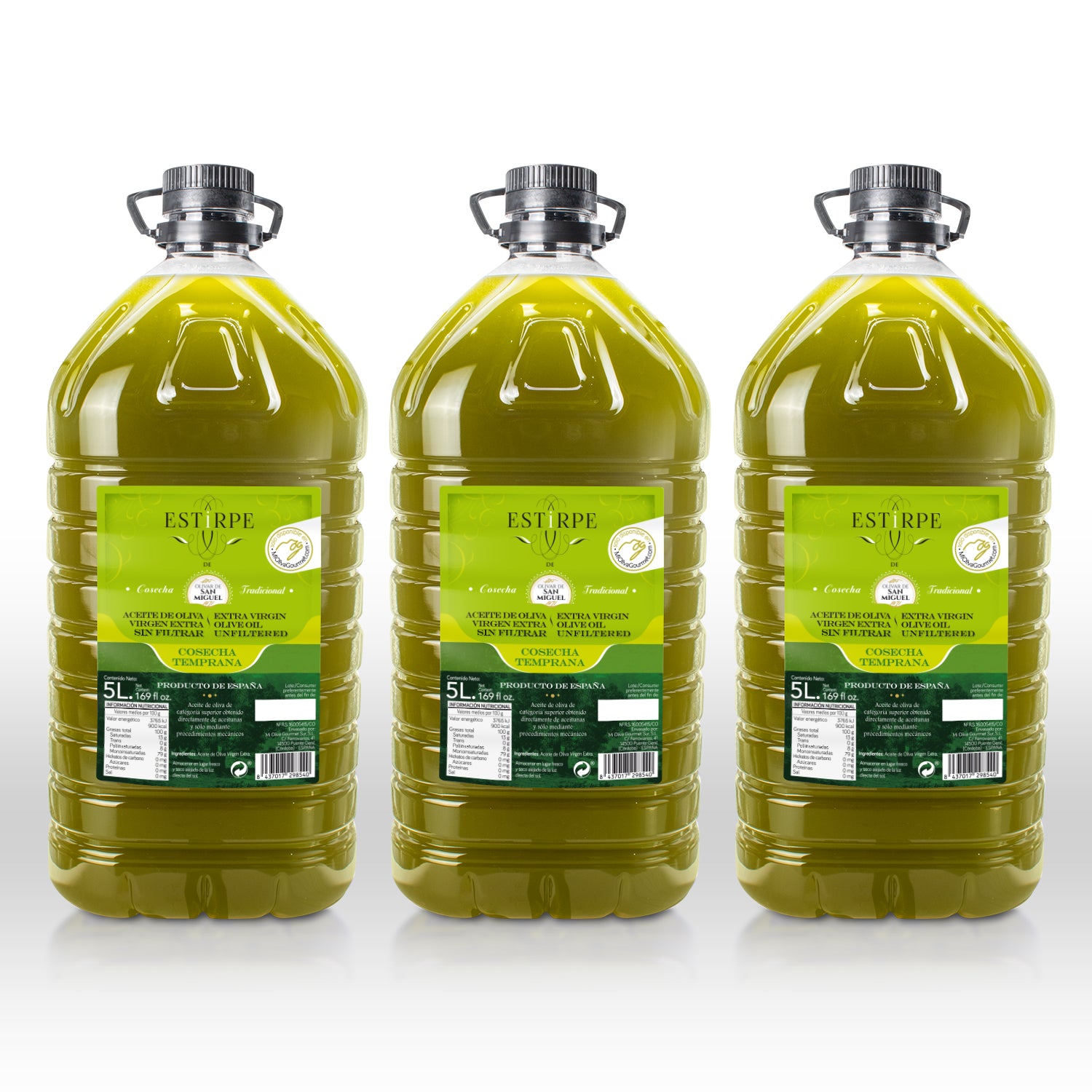
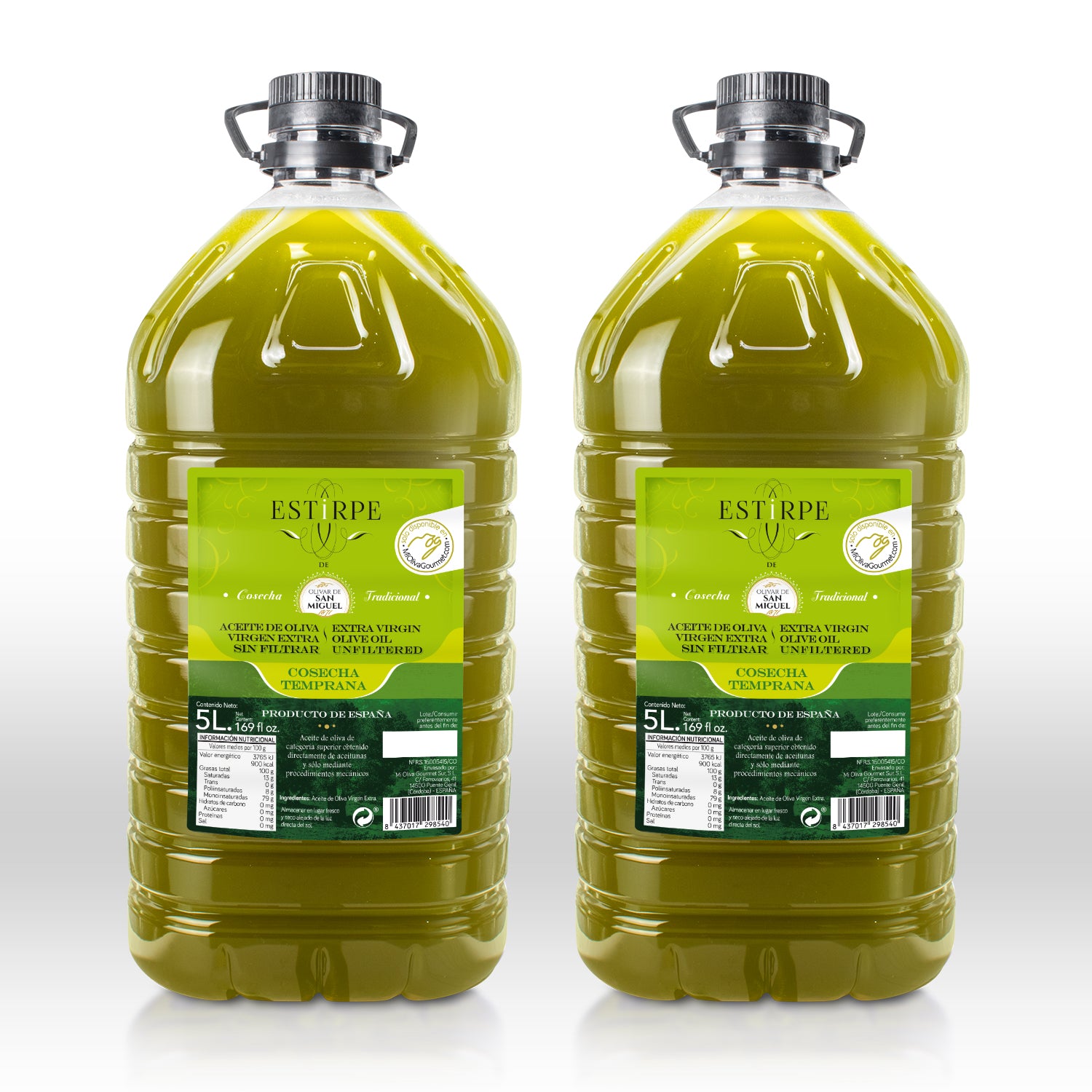
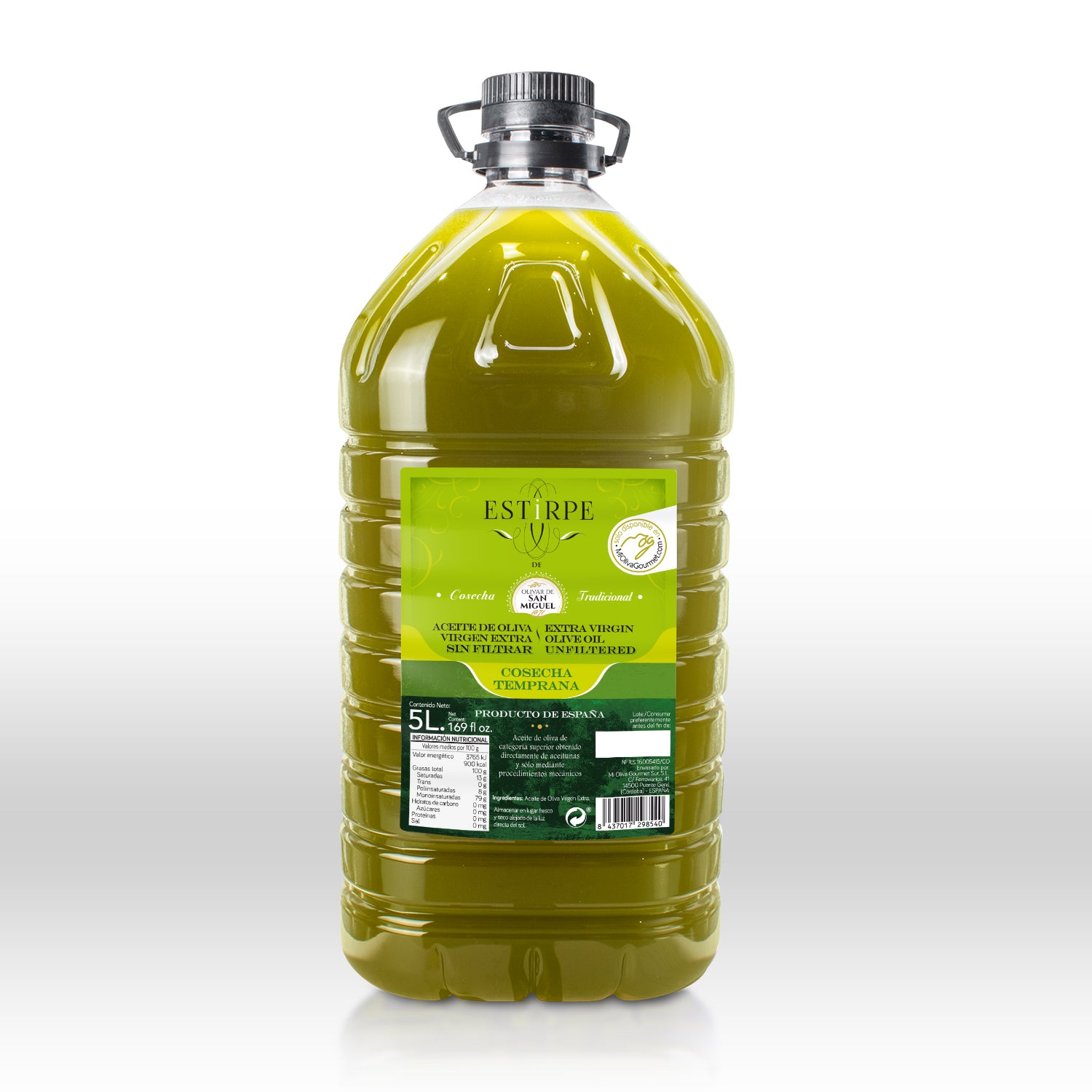
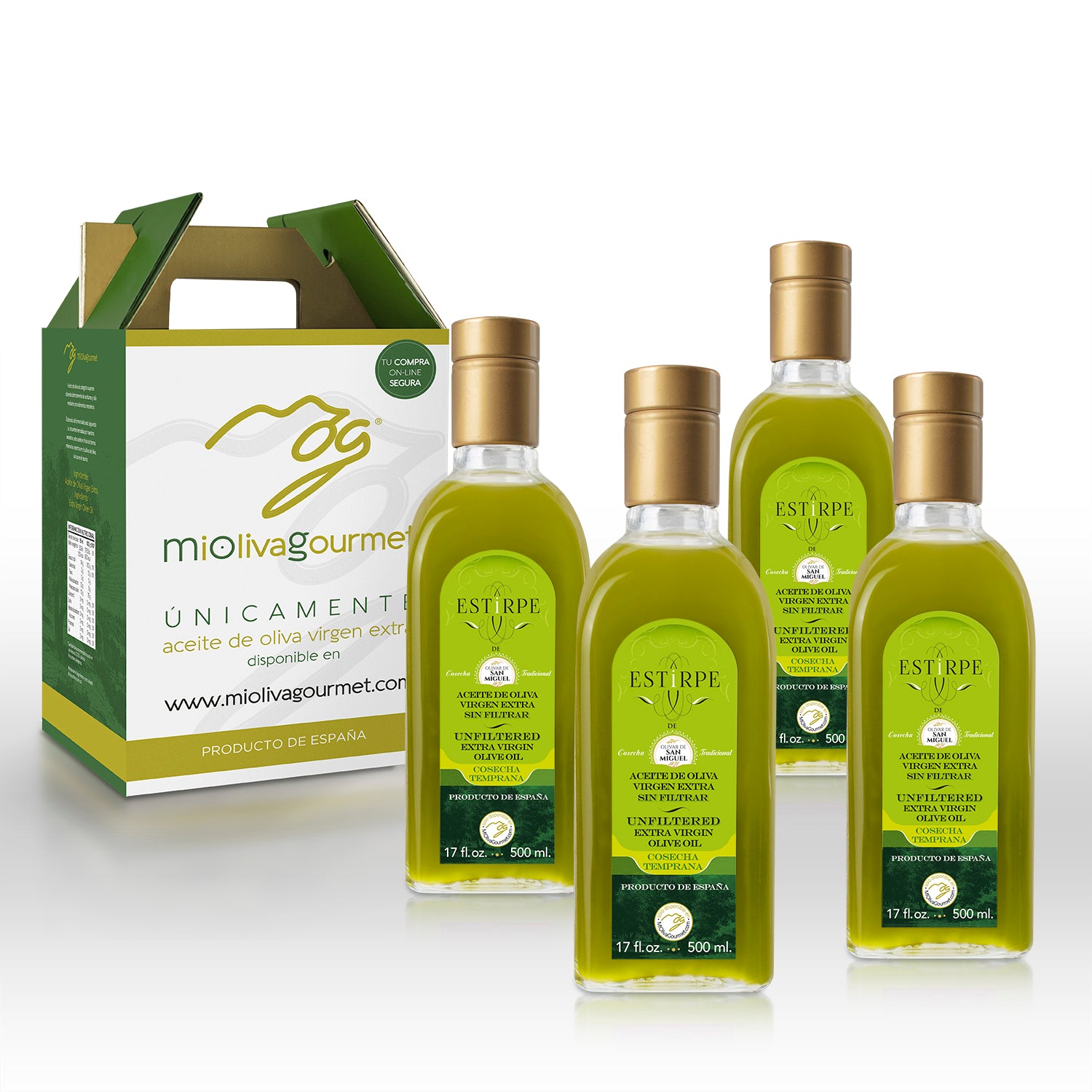
Even so, it works out cheaper than you might think. The box of 2 × 5-liter jerrycans comes to €11.90 per liter. Taking the recommended daily amount as a reference, one tablespoon, roughly 20 ml, that's less than 24 cents a day. We spend far more on plenty of foods we keep at home that have no place in a healthy diet.
Take a bag of potato chips: if you do the math, you'll realize you're paying €12–15 per kilo of chips. So often, when it comes to what really matters for our health, we count every cent, and turn a blind eye to other things that are actually bad for us.
| Ripe olive oil | Early harvest olive oil | |
|---|---|---|
| When it's picked | ❌ December–February | ✅ October–November |
| Oil per kilo of olives | ❌ More | ✅ Much less |
| Color | ❌ Yellow or golden | ✅ Intense green |
| Aroma | ❌ Ripe fruit | ✅ Grass, leaf and green fruit |
| Flavor | ❌ Smooth and sweet | ✅ Intensely fruity, with a bitter and peppery finish |
| Polyphenols | ❌ Fewer | ✅ More |
| How long it's freshly pressed | — | ✅ A few days a year |
👉 Reserve your early harvest olive oil
Why can you only enjoy it freshly pressed a few days a year?
Because freshly pressed only happens once a year: right after the first milling. From then on, the oil starts to settle. If it's unfiltered, like ours, it keeps more olive particles and more flavor, but it's also best enjoyed sooner. The “first oil of the year” experience lasts just a few days.
Most oils you buy at the supermarket don't reach you freshly pressed. They're bottled, stored and sold over months. Freshly milled early harvest oil is something else entirely: it's the juice just as it comes out of the mill.
That's why we don't keep it in stock. It's reserved before milling and goes straight from the mill to your door in less than 48 hours.
Filtered or unfiltered? We explain it in the differences between unfiltered and filtered olive oil. And if the color worries you: why olive oil changes color over time.
How can you tell if an olive oil is genuinely early harvest?
Check three things: that the label states the season (for example 2026/27) or the bottling date (it should be very recent), that the oil is extra virgin, and that it tastes bitter and peppery. A genuine early harvest olive oil is greenish, smells of grass and has a slight peppery kick at the end. If it's sweet and flat, whatever the label says, the olives were already ripe or the oil has been blended with leftover stock from the previous season.

- ✅ It states the harvest season. Without it, you don't know when it was made.
- ✅ It's extra virgin. No other category will do.
- ✅ It smells green: freshly cut grass, olive leaf, tomato vine.
- ✅ It's slightly bitter and catches in the throat. That's the polyphenols talking.
- ✅ You know who makes it. A grower with a first and last name.
For everything else: how to read an olive oil label.
Where to get our early harvest olive oil
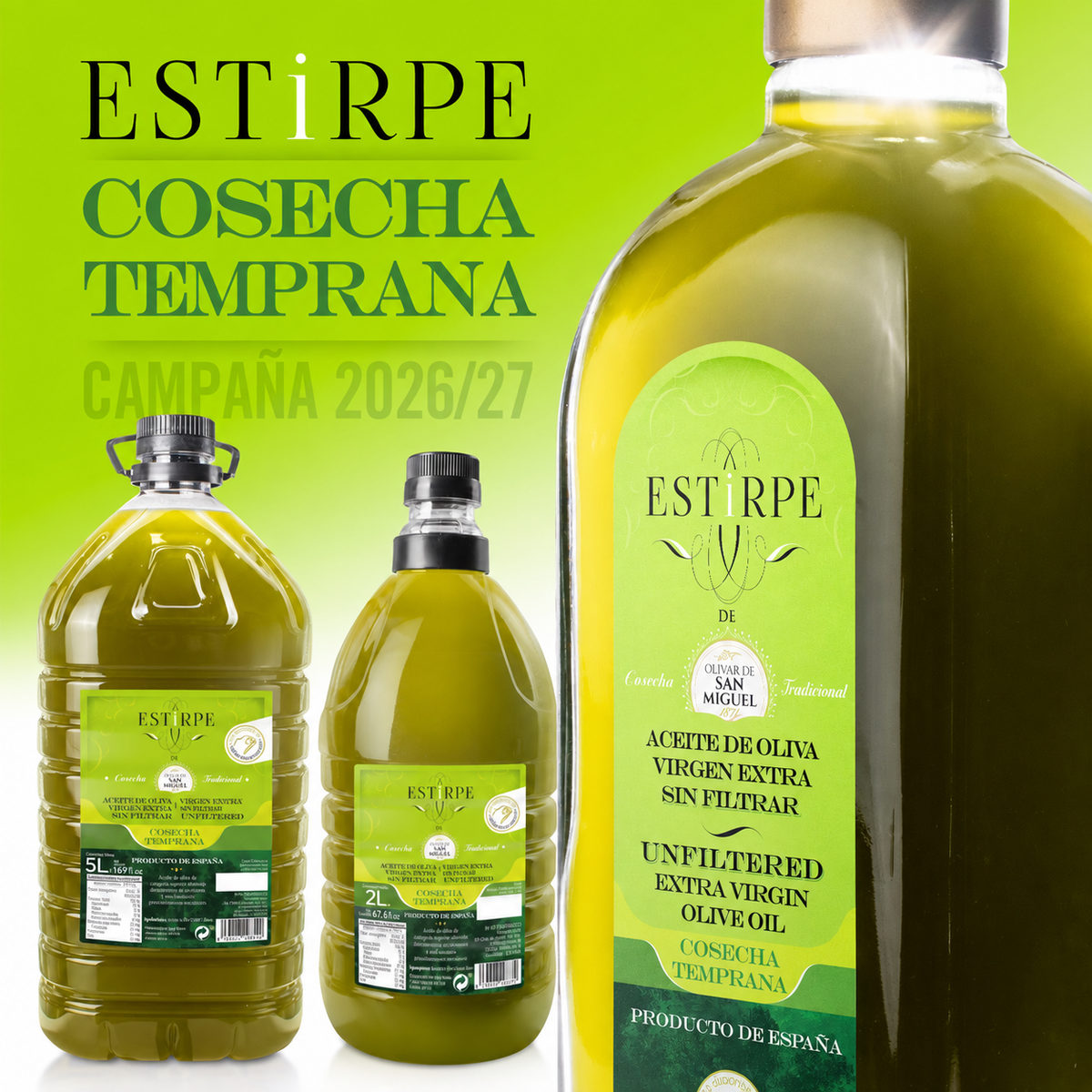
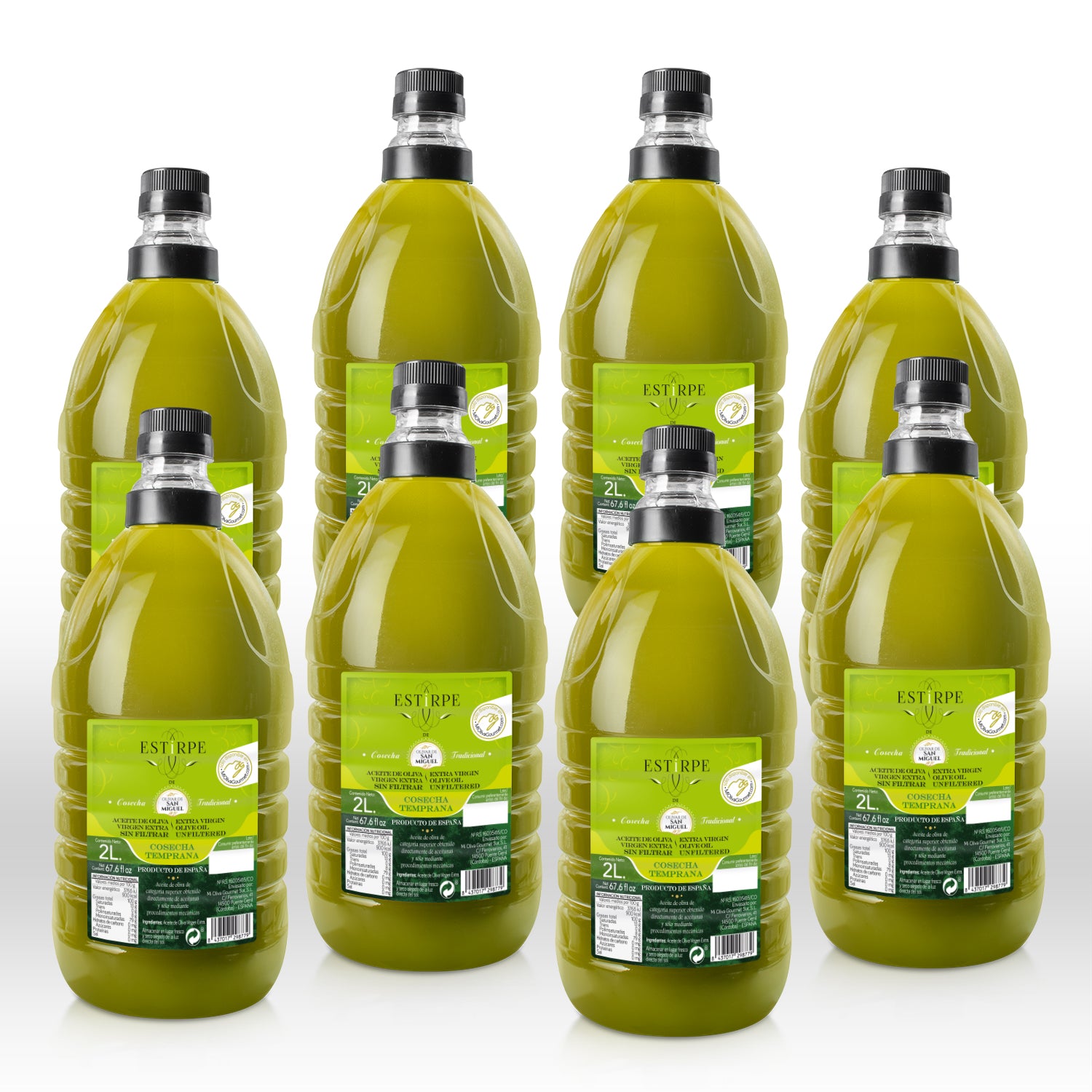
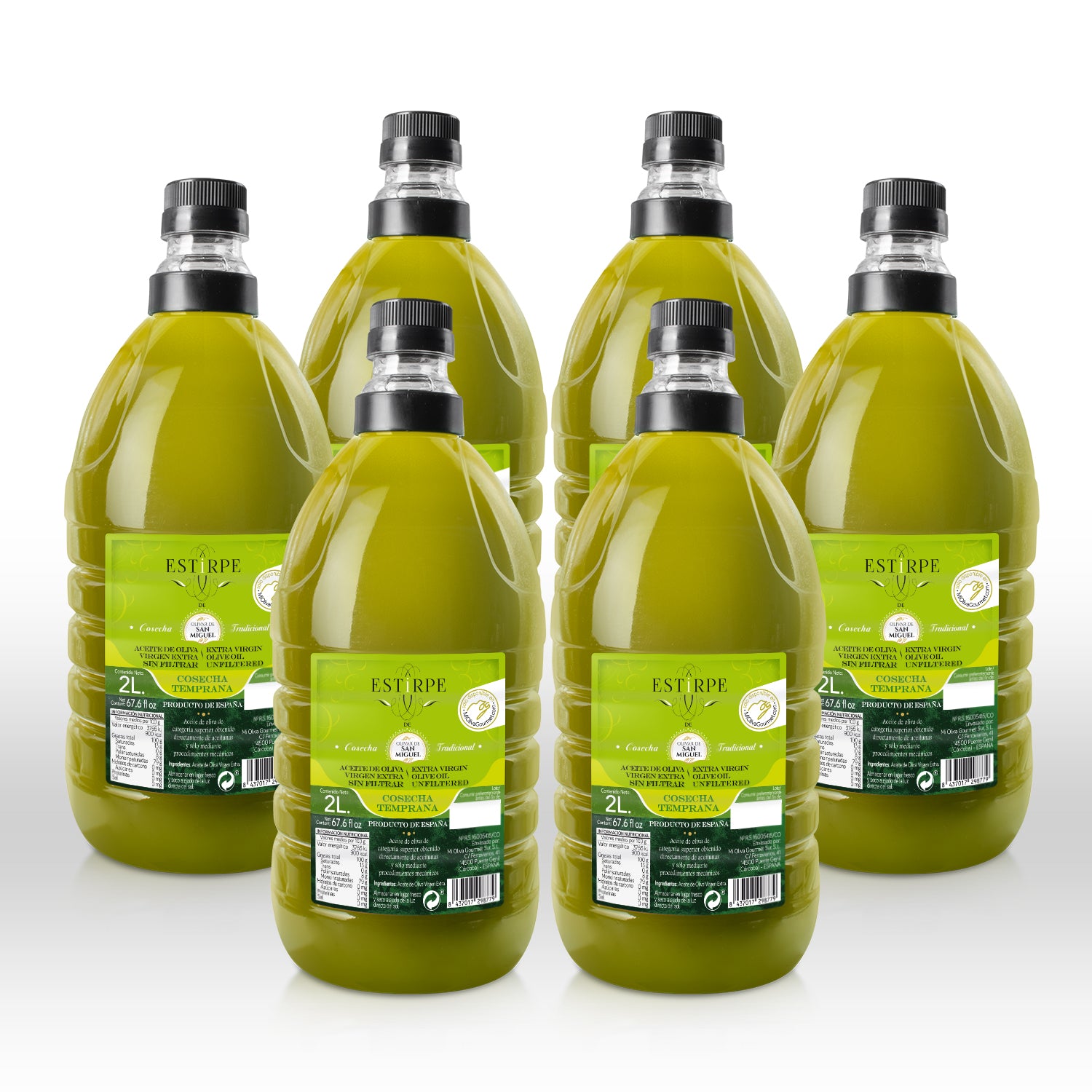
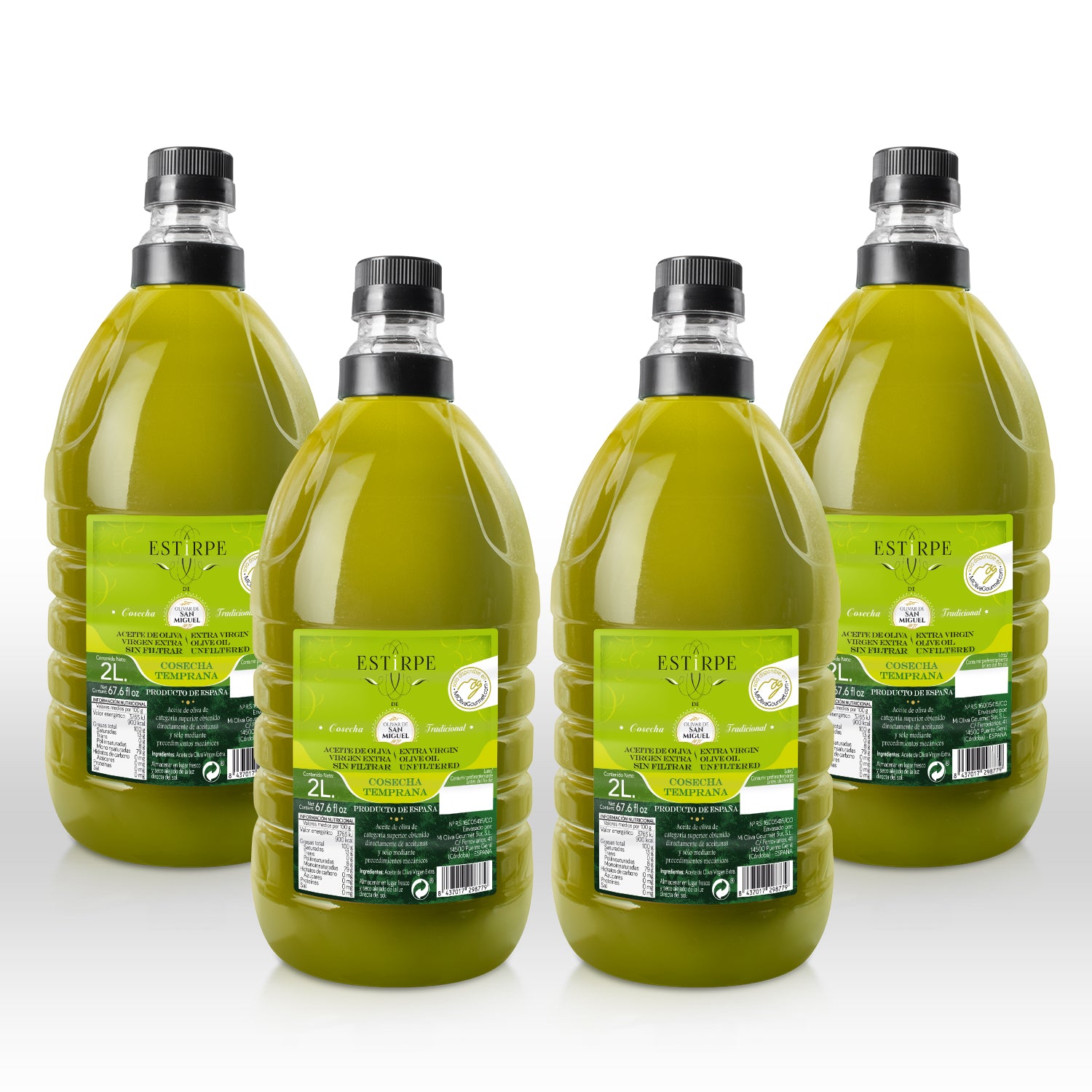
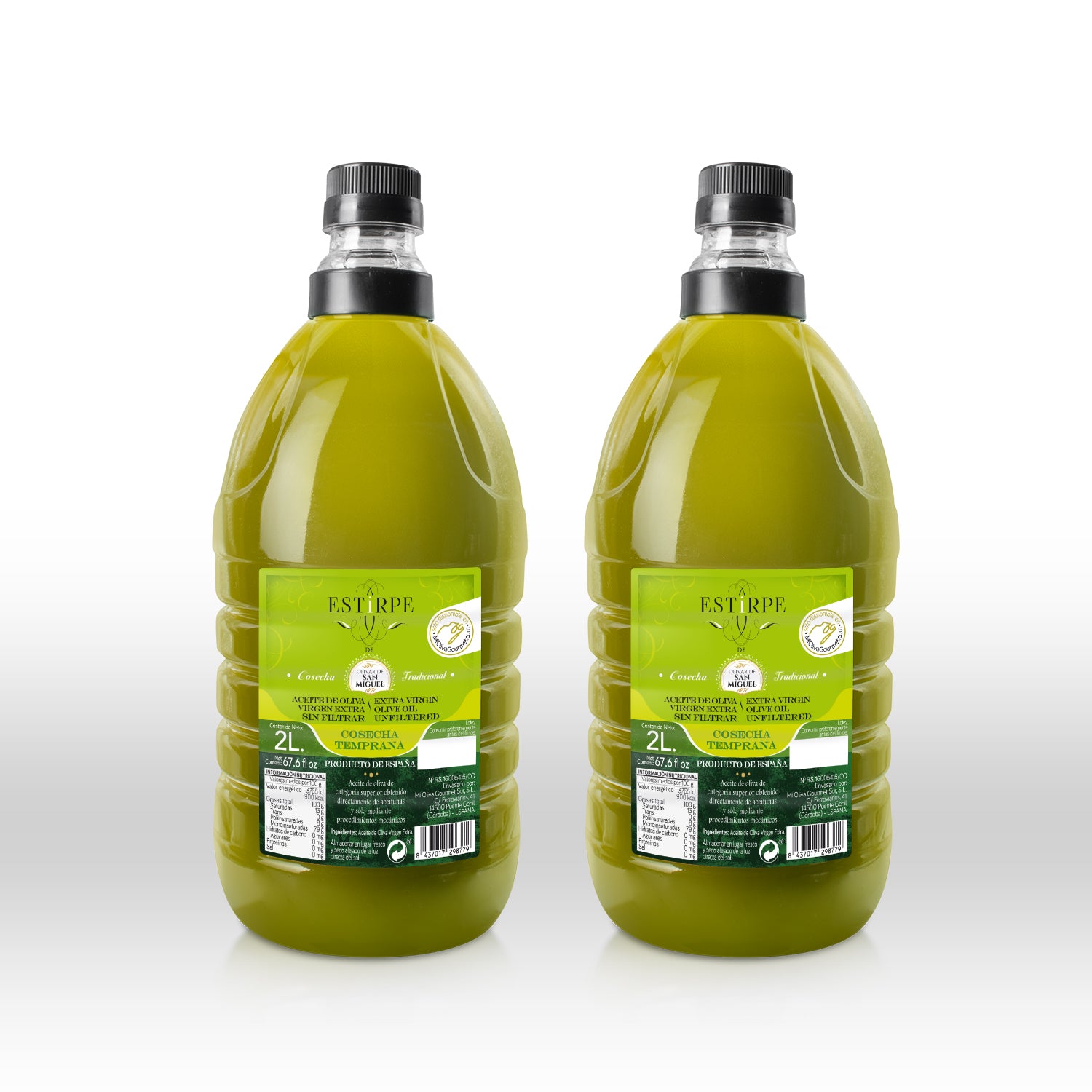
Ours is called Estirpe Early Harvest: an unfiltered extra virgin olive oil we make from the first olives of Migue's grove in Puente Genil. It's only available by reservation, because it's made once a year and orders are fulfilled strictly first come, first served.
 |
|
Tap here to reserve this year's Estirpe Early Harvest
What people who've tried it tell us
|
★★★★★ “Splendid oil. Pure, freshly squeezed juice. Since I first tried it, I haven't been able to switch.” Yolanda · Verified buyer |
|
★★★★★ “I had my doubts about the oil… but it was a lovely surprise. It took me back to my childhood, with a delicious flavor: intense green, dense, real olive juice, and beautifully balanced, just the right pepperiness and bitterness. I'll definitely be ordering again!” Roberto De Miguel · Verified buyer |
|
★★★★★ “I really liked this unfiltered early harvest oil, perfect for enjoying on toast and in salads. It has an intense aroma and a very fruity flavor, full of nuances and very smooth, with a moderate peppery note.” Alberto Burgos · Verified buyer |
Your oil cruet, on us
Freshly pressed olive oil needs protecting from light and air.
That's why, if it's your first order, we'll give you our opaque glass drip-free oil cruet (€22.45): reserve your oil, add the cruet to your cart and use this discount code at checkout:
ACEITERA-GRATIS
When you reserve your Estirpe Early Harvest, the cruet is FREE
👉 Reserve your early harvest (FREE oil cruet)
Two options:
❌ Option 1Stick with an oil that's been bottled for months, mild and flat, and never know what freshly pressed early harvest olive oil tastes like. |
✅ Option 2Reserve the first oil of the year, green, unfiltered and freshly milled, for less than 24 cents a day, and feel that peppery kick that tells you it's alive. |
The choice is yours.
How should you enjoy early harvest olive oil?
Raw, to appreciate everything it has to offer. Try it on its own first, on a white plate or a spoon: you'll see the color, smell the olive and feel the pepperiness. Then drizzle it over a slice of good toasted bread, on salads or over a freshly finished dish. Store it somewhere cool and dark.

Frequently asked questions
What does “early harvest” mean on an olive oil?
That it was made from olives picked at the start of the season, still green or in veraison, between October and November. It yields less oil, but greener, more aromatic and richer in polyphenols.
Is early harvest olive oil better?
It's more intense and has more polyphenols. If you like a smooth, sweet oil, you might prefer one made from ripe olives. If you're after flavor, aroma and freshness, early harvest is in a league of its own.
Why is early harvest olive oil peppery?
Because of oleocanthal, one of its polyphenols. You feel it in the throat, not on the tongue. It's a sign of freshness and quality.
Can you cook with early harvest olive oil?
Yes, it handles heat like any extra virgin. But it's raw that you really notice everything that makes it special.
How long does early harvest olive oil last?
Stored properly, it keeps its quality for many months. But the experience of enjoying it freshly pressed, straight from the mill, only lasts a few days a year.
When will the 2026/27 Estirpe Early Harvest arrive?
We expect it around mid-November, weather permitting. It goes from the mill to your door in less than 48 hours, and reservations are fulfilled strictly first come, first served.
What if I don't like it?
You can return it. That's how confident we are.
👉 Click here to reserve the first oil of the year
In the interview, Migue said something we haven't forgotten: “Some years this is tough. Bad weather comes along and in half an hour a whole harvest is gone. But we've carried on the tradition, and let's hope I'm not the last.” Every reservation helps make sure he isn't.
P.S.: If for any reason you don't love it, you can return it. No questions asked. That's how sure we are you'll taste the difference from the very first spoonful.
P.P.S.: Freshly pressed only happens once a year. Reserve now and it'll be at your door less than 48 hours after milling, for less than 24 cents a day.
Julio César de la Vega Fernández, co-founder of Mi Oliva Gourmet alongside Ricardo and Miguel Morales Chacón (Migue), fourth-generation olive growers in Puente Genil, Córdoba.




Leave a comment
This site is protected by hCaptcha and the hCaptcha Privacy Policy and Terms of Service apply.