
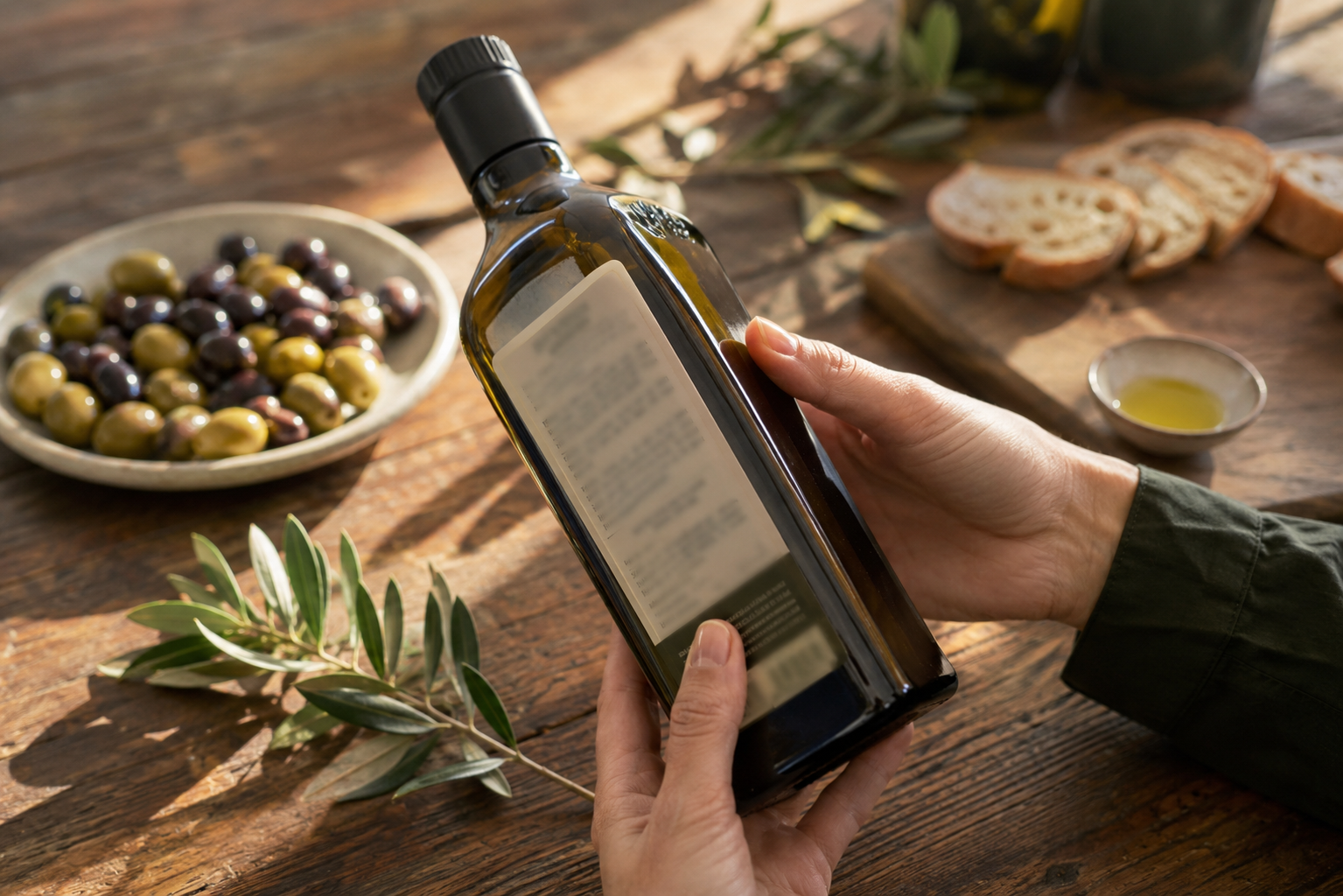
How to Read an Olive Oil Label (and Know What You're Really Buying)
📅 Updated: August 2026
Between 2022 and 2024, the price of olive oil in Spain nearly tripled. You saw it on the supermarket shelf and you saw it on your receipt. Meanwhile, the labels kept saying the same old things: “extra virgin,” “intense,” “superior quality.”
Spain produces more olive oil than any other country in the world. Even so, most people who buy olive oil every week struggle to tell a genuine extra virgin from a well-dressed bottle.
The good news is that the label tells you almost everything. You just need to know where to look. In this article, you’ll learn to read it in 30 seconds, with a final list of five checks that fit in a single phone photo.
And here’s a sneak peek: one of the most valuable clues is a detail many bottles would rather keep quiet. We’ll tell you which one further down.

In this article:
- What’s the difference between “olive oil” and “extra virgin olive oil”?
- What exactly does “extra virgin” guarantee?
- Why does “blend of EU olive oils” say so little?
- Harvest date or best-before date: which matters more?
- Why does a good extra virgin catch the back of your throat?
- 5 checks before a bottle goes in your cart
- So how does all this apply to our oil?
- Frequently asked questions
What’s the difference between “olive oil” and “extra virgin olive oil”?
They are two distinct legal categories. Plain “olive oil” is a blend of industrially refined oil with a share of virgin oil added back to restore some color and aroma. Extra virgin is olive juice extracted solely by mechanical means, with zero defects and a maximum acidity of 0.8°.
In the supermarket aisle, nearly identical bottles sit side by side: same brand, same design, same shelf. The difference comes down to a single word: virgin.
When the label says only “olive oil” (and, in smaller print, “contains exclusively refined olive oils and virgin olive oils”), you’re looking at an oil that has gone through industrial refining: neutralization, bleaching and high-temperature deodorization. That process strips out the defects of the original oil and, along the way, its aroma, its flavor and much of its natural compounds. A portion of virgin oil is then added (the law doesn’t require stating how much) to give it back a golden hue and a hint of recognizable aroma.
It’s a legal product and safe to eat. And it’s a world away from an extra virgin.
| What the label says | What’s inside | Maximum acidity |
|---|---|---|
| Extra virgin olive oil | Olive juice, mechanical processes only, zero defects in official tasting | 0.8° |
| Virgin olive oil | Olive juice, slight defects allowed | 2° |
| Olive oil (plain) | Refined oil + a share of added virgin oil | 1° |
| Olive pomace oil | Solvent-extracted from pressing residues, refined + added virgin oil | 1° |
Lampante oil deserves a special mention: it’s virgin oil with too many defects to be eaten as is. It can’t be bottled and sold to consumers; it goes to the refinery instead. That’s where the base for plain “olive oil” comes from.
An important note on acidity: it’s a lab parameter and you can’t taste it. We explain what olive oil acidity really means in a dedicated article. What’s more, in refined oils it is artificially lowered during processing, so as a quality clue it only works when comparing virgin oils.
What exactly does “extra virgin” guarantee?
“Extra virgin” is the highest category recognized by European law: oil extracted from the olive solely by mechanical means, with acidity of 0.8° or less, and approved by an official tasting panel that confirms zero defects and a present fruitiness. It is, quite literally, olive juice at its best.
To carry those two words, every batch must pass two tests: a lab test (acidity, peroxide value and other physicochemical parameters) and a sensory test before an accredited tasting panel. If the panel detects even one defect, the oil is downgraded. Plain “virgin,” for example, allows slight defects and acidity of up to 2°.
Current regulations (Delegated Regulation (EU) 2022/2104, which replaced the previous rules in 2022) also require the label to show, clearly legible and in the main field of vision: the oil’s category, storage conditions, place of origin and the identity of the bottler.
In other words, the key information has to be there. How much it actually tells you is another matter. Let’s start with the first one.
Why does “blend of EU olive oils” say so little?
The law requires the origin to be stated on virgin and extra virgin oils, but when the oil comes from mixed sources it allows generic wording: “European Union,” “non-EU” or “EU and non-EU.” The bottle complies with the rules, and you’re left with no idea which country, region or mill the oil came from.
With olive oil, origin directly shapes flavor, freshness and a fair price. A blend of tanks from various sources, adjusted to taste the same all year round in any country, is a product designed for mass distribution. An oil from a specific estate and a specific season changes from one year to the next, just as the land does, and that’s precisely why its label can afford to give you concrete details.
How do you recognize real traceability? There are two routes:
1. A Protected Designation of Origin seal. Spain has around thirty olive oil PDOs (Baena, Priego de Córdoba, Estepa, Sierra Mágina…). The seal guarantees that 100% of the olives come from a defined geographical area, verified by an independent regulatory council, a third party with no ties to the brand.
2. A producer with a name and a face. When you know which estate, which family and which mill are behind the bottle, and you can write or call them with questions, traceability no longer depends on a seal: it’s right in front of you. This is the model of the producer who bottles their own harvest and stands behind it. In fact, we’ve already covered the 3 differences between a gourmet oil and the rest, and none of the three appears on the label.
Words like “traditional,” “special selection” or “superior quality,” on the other hand, are written by the marketing department, and no authority audits them.
Harvest date or best-before date: which matters more?
The “best before” date is usually set one or two years after bottling, and it speaks about the packaging: one year for unfiltered oils and two years for filtered ones. The harvest season speaks about the oil itself: European regulations only allow it on the label when 100% of the oil comes from that season. That’s why many blended bottles can’t show it.
This is the detail many bottles would rather keep quiet.
In Spain, olives are harvested roughly between October and January. Everything bottled during the rest of the year comes out of storage tanks. And with polyphenols (the compounds responsible for bitterness, pepperiness and much of the oil’s value), time is not on your side: they break down over the months, with heat and with light.
In fact, the only health claim authorized in Europe for olive oil refers to them: olive oil polyphenols contribute to the protection of blood lipids from oxidative stress, and the authorization requires the oil to retain a minimum concentration of these compounds. An oil from a recent harvest holds on to far more than one bottled two years ago and left under the fluorescent lights of a supermarket or hypermarket shelf.
The rule of thumb is simple: if you see a filtered oil (the only kind usually sold on store shelves) with a “best before” date, it was bottled two years earlier. That tells you, at the very least, which season it comes from. We bottle daily, we don’t stockpile (to preserve the oil’s qualities), and our EVOO never carries over from one season to the next: our EVOO is always from the latest harvest.
At home, protect what the label promises: keep it away from heat and direct light, ideally in dark glass or a tin rather than clear glass.
Why does a good extra virgin catch the back of your throat?
That peppery tickle at the back of your throat comes from oleocanthal, a natural compound found in fresh oil. Researchers at the Monell Chemical Senses Center reported in the journal Nature (2005) that it shares a mechanism with ibuprofen: the very same stinging sensation and a remarkably similar anti-inflammatory profile. The fresher and less processed the oil, the more oleocanthal it contains.
The story behind the discovery is a delight: an American biologist, Gary Beauchamp, tasted freshly pressed oil at a tasting and instantly recognized a throat sting he already knew… from his studies on ibuprofen. That hunch led to the research published in Nature.

For you, standing in front of the bottle, the lesson is practical: a light bitterness and a peppery finish are living polyphenols saying hello. A flat, sweet, completely neutral oil is also telling you its story: lots of blending, lots of tank time or a long while in the bottle.
A fair caveat: pepperiness varies by variety. An Arbequino is naturally more delicate than a Picual, and both can be magnificent extra virgins. The warning sign is a total absence of bitterness and pepperiness.
Try a Picual with the peppery kick it should have
5 checks before a bottle goes in your cart
Check the legal category, the origin, the harvest season and the packaging, then do the pepperiness test at home. Five checks, thirty seconds, and advertising no longer makes the decision for you.
- The legal category. Look for “extra virgin olive oil,” in those exact words. Plain “olive oil” is refined oil with added virgin oil; “olive pomace oil” is extracted with solvents from pressing residues.
- The origin. Specific (town, region, estate or PDO seal) beats generic (“EU,” “blend of olive oils from the European Union”).
- The harvest season, and if it’s missing, work it out. It can only appear if all the oil comes from that season. If it’s there, that’s a guarantee of freshness. If it isn’t, subtract two years from the “best before” date on a filtered oil: that’s, at the very least, the season it comes from.
- The packaging. Dark glass or tins protect polyphenols. Clear glass exposes them to light. Our EVOOs are always kept in tanks: we bottle them and ship them in a closed, opaque box, and we’ve developed a patented oil cruet to preserve their properties as fully as possible.
- The final test, at home. Fruity on the nose, a light bitterness and that peppery sting at the back of the throat: living oil.
| ❌ Be wary when all you see is… | ✅ Trust it when you find… |
|---|---|
| Words nobody audits: “traditional,” “special selection,” “superior quality” | Verifiable facts: legal category, variety, who makes it |
| Generic origin: “blend of EU olive oils” | A named estate, region or PDO |
| No harvest season and a “best before” date that’s already close: it’s been bottled a while | A visible harvest season, or a “best before” date still far off (recently bottled) |
| Clear glass on a brightly lit shelf | Dark glass or a tin |
| Flat, sweet, neutral flavor | Fruity, lightly bitter, peppery finish |
So how does all this apply to our oil?
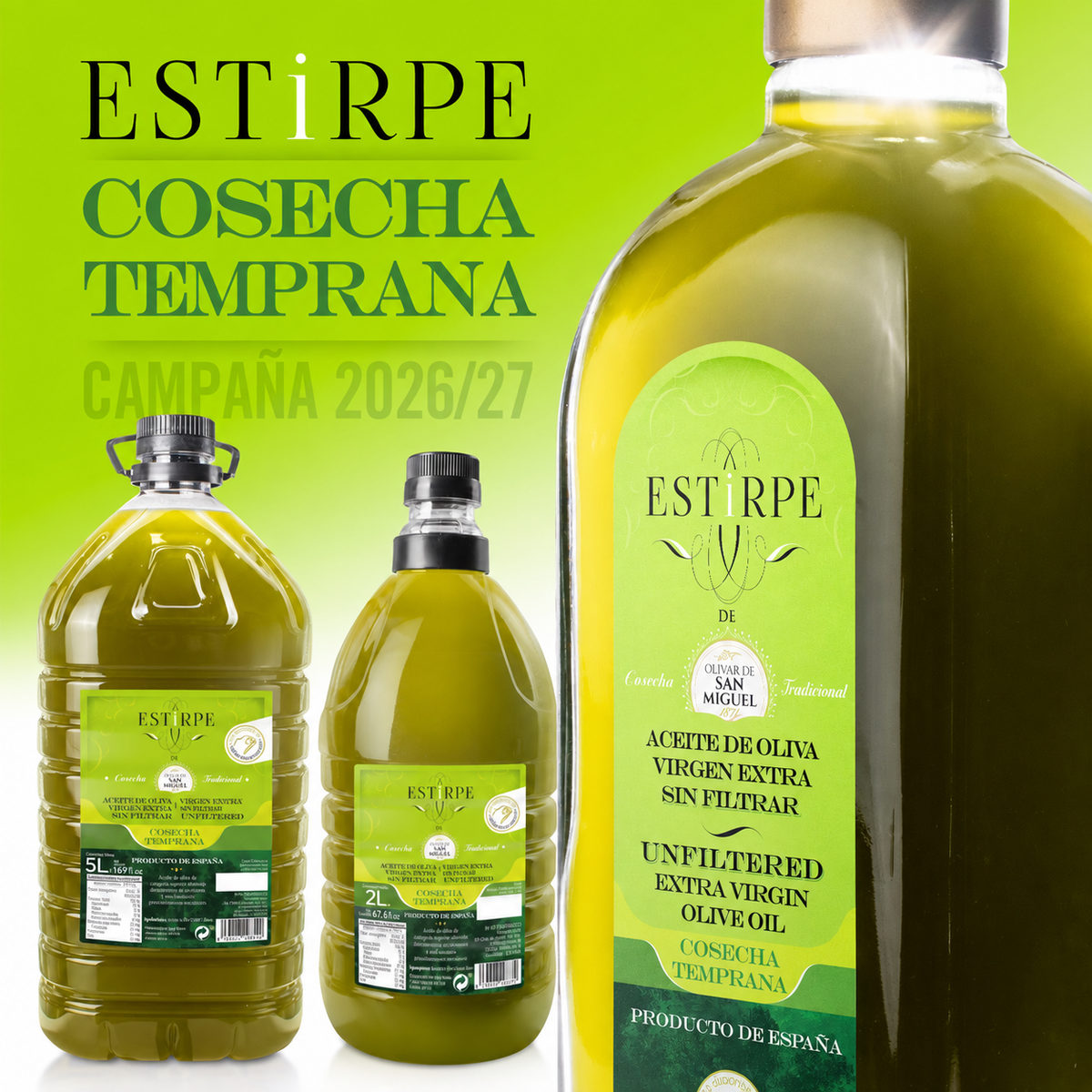
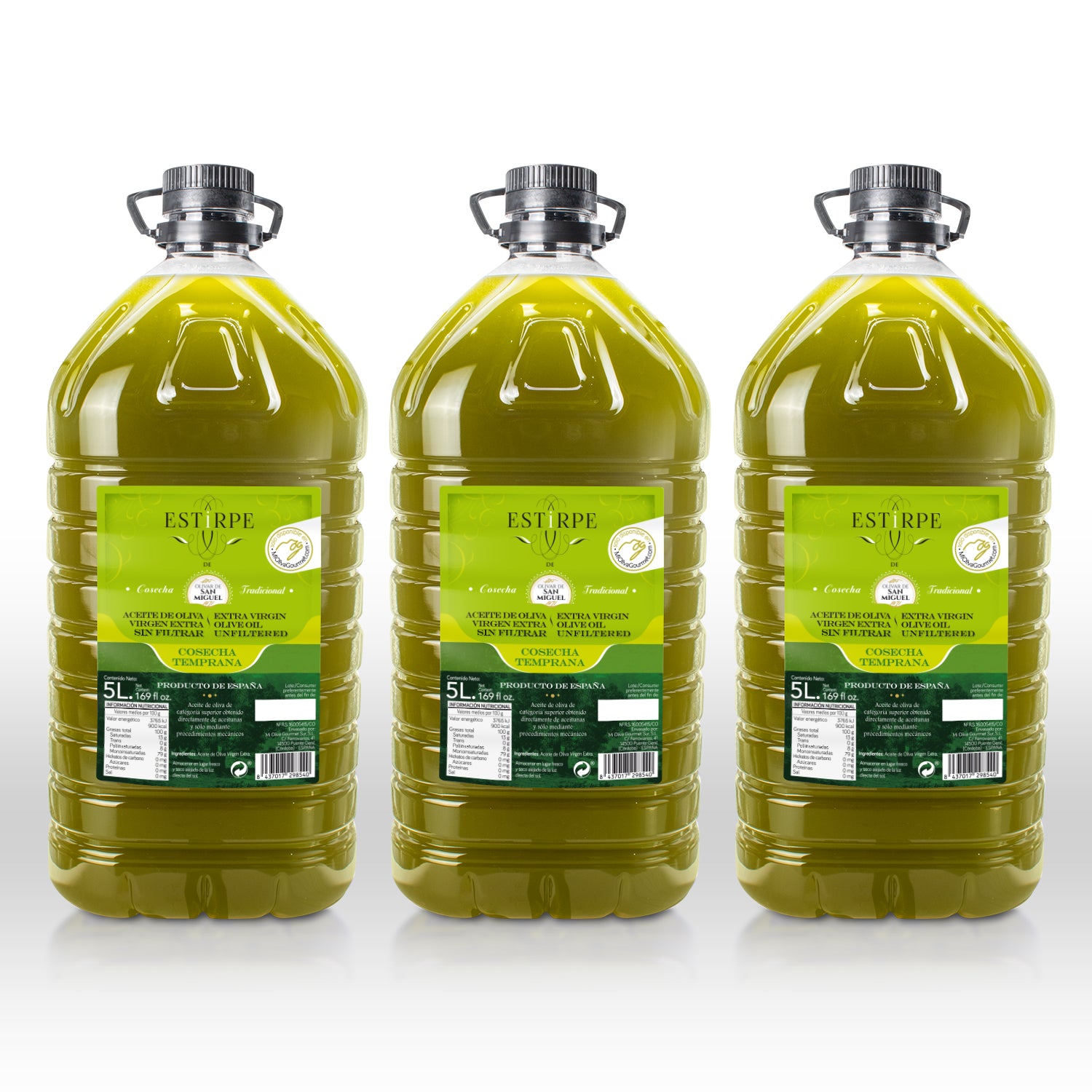
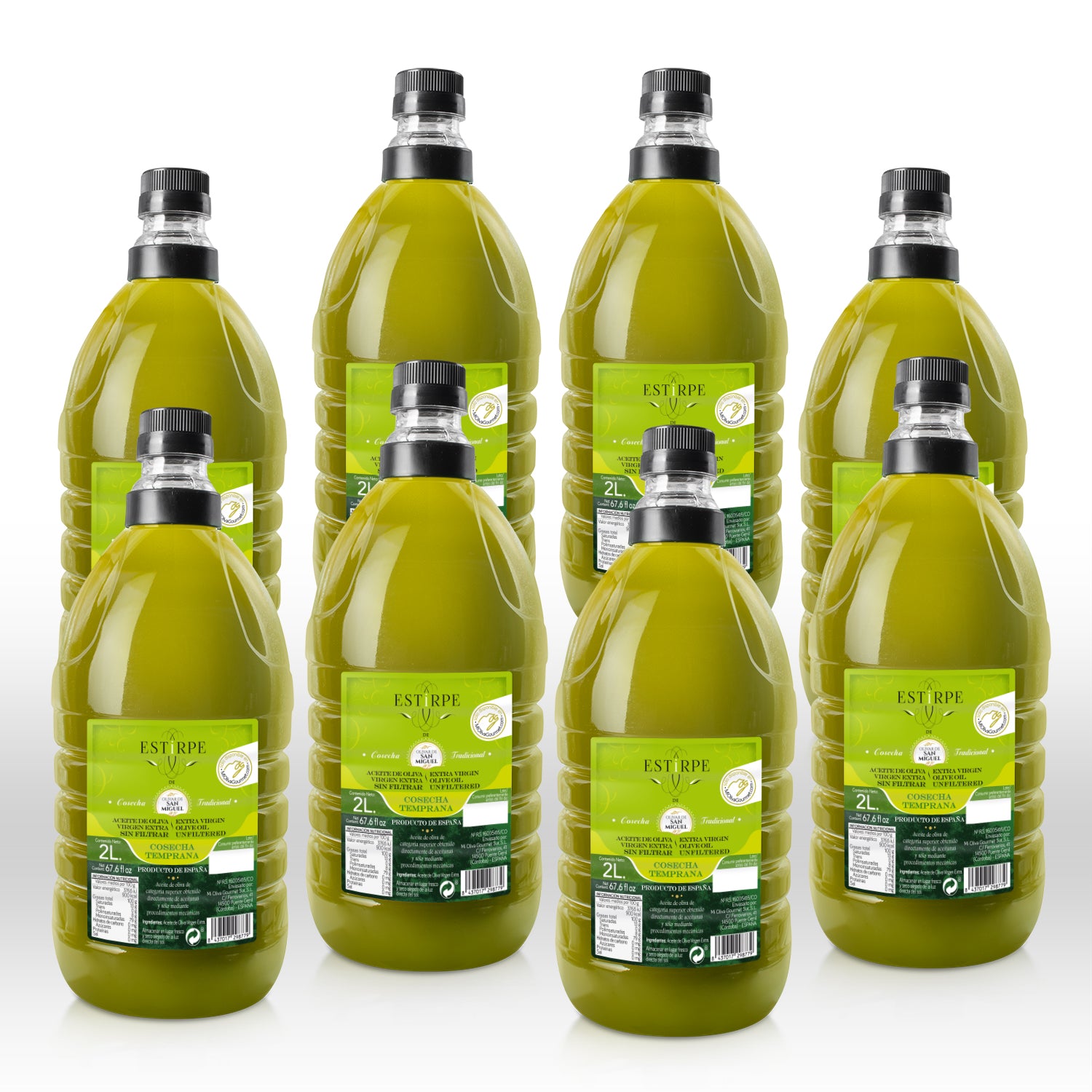
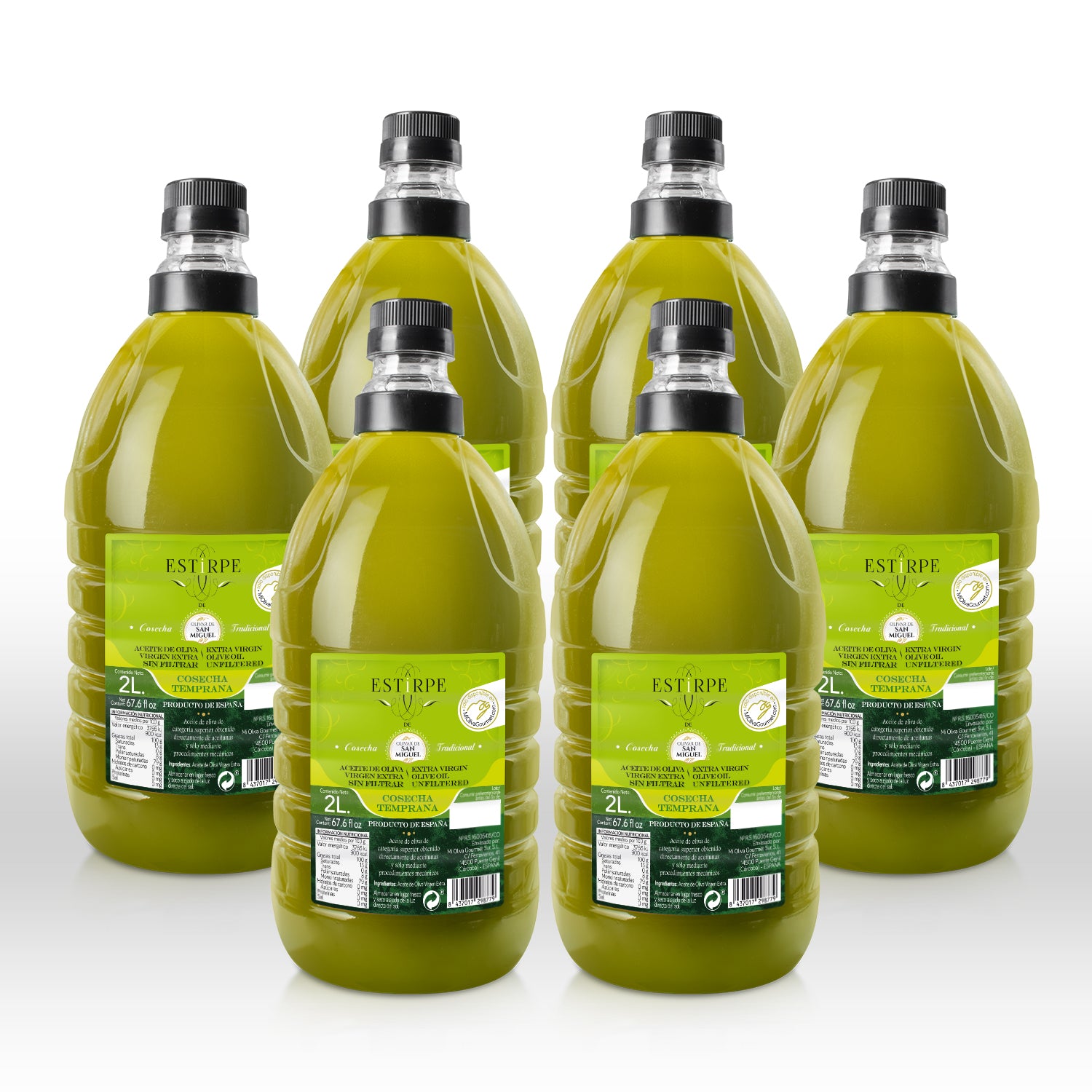
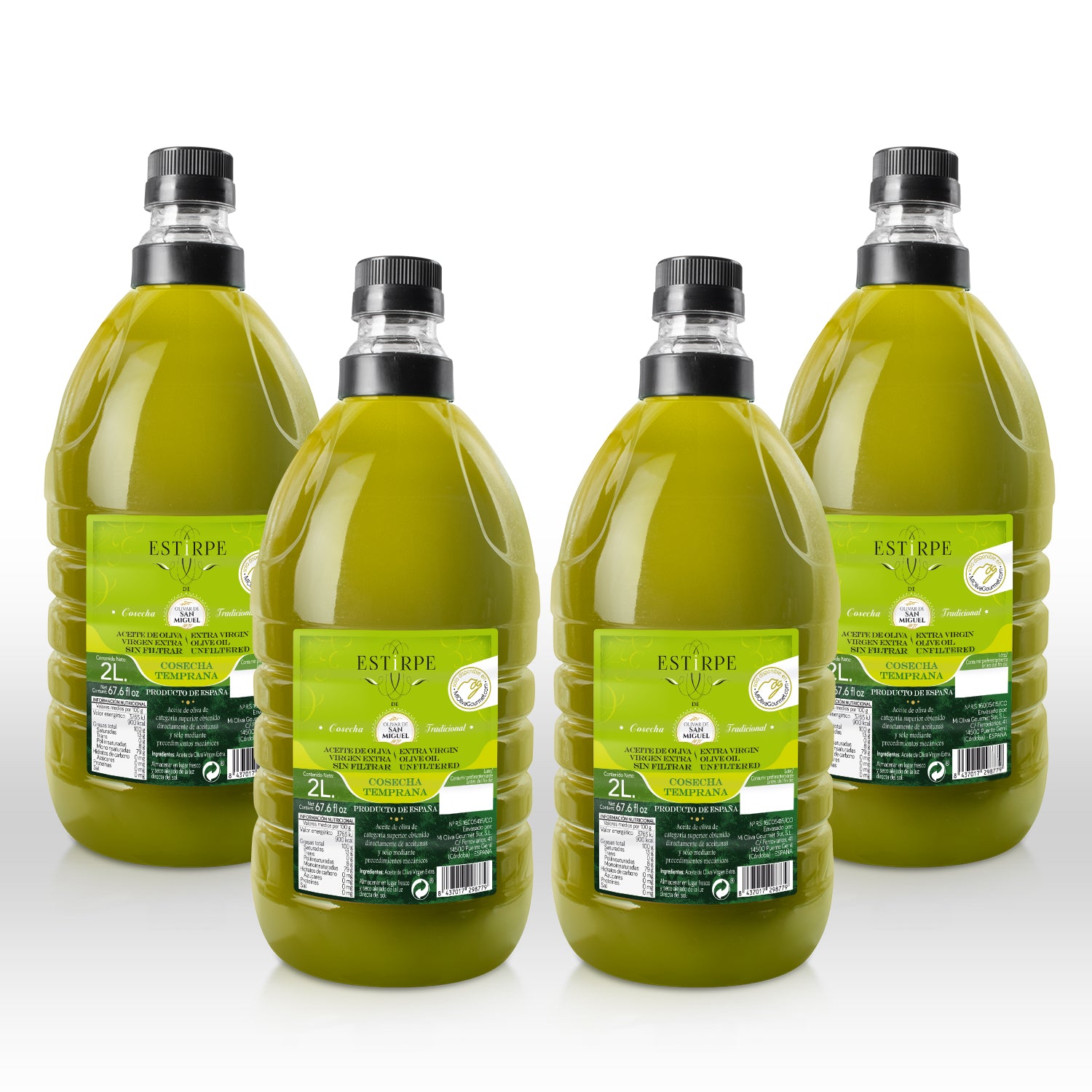
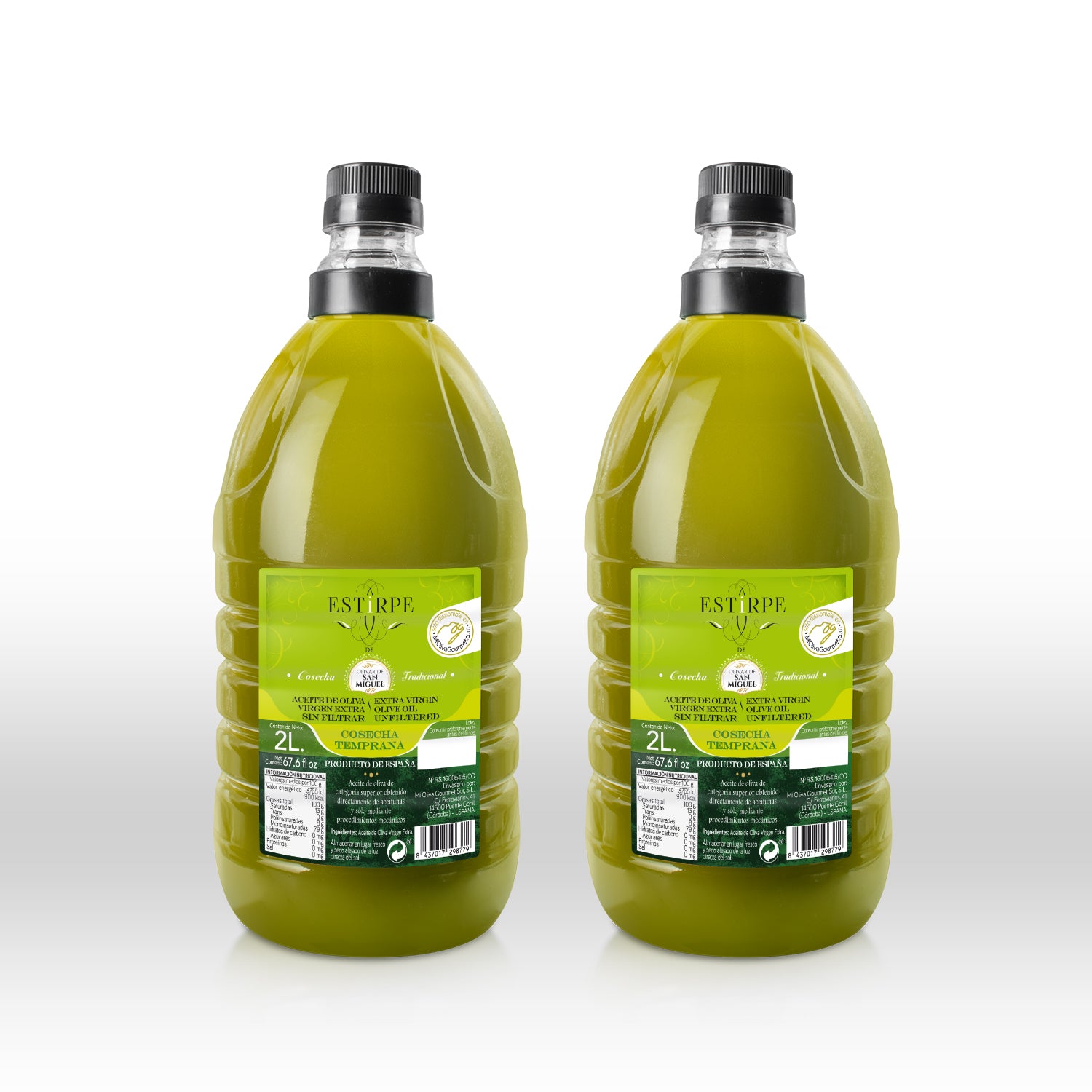
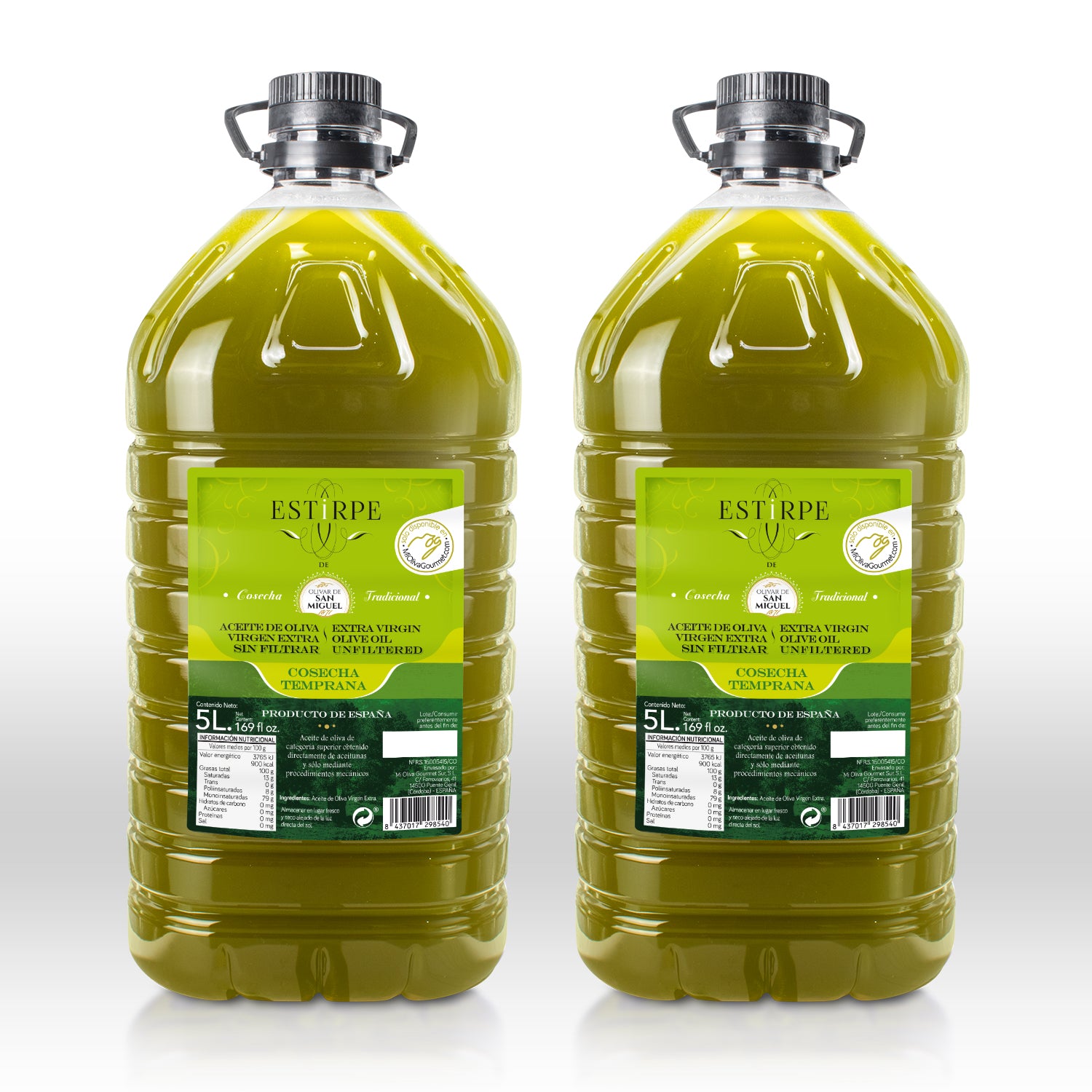
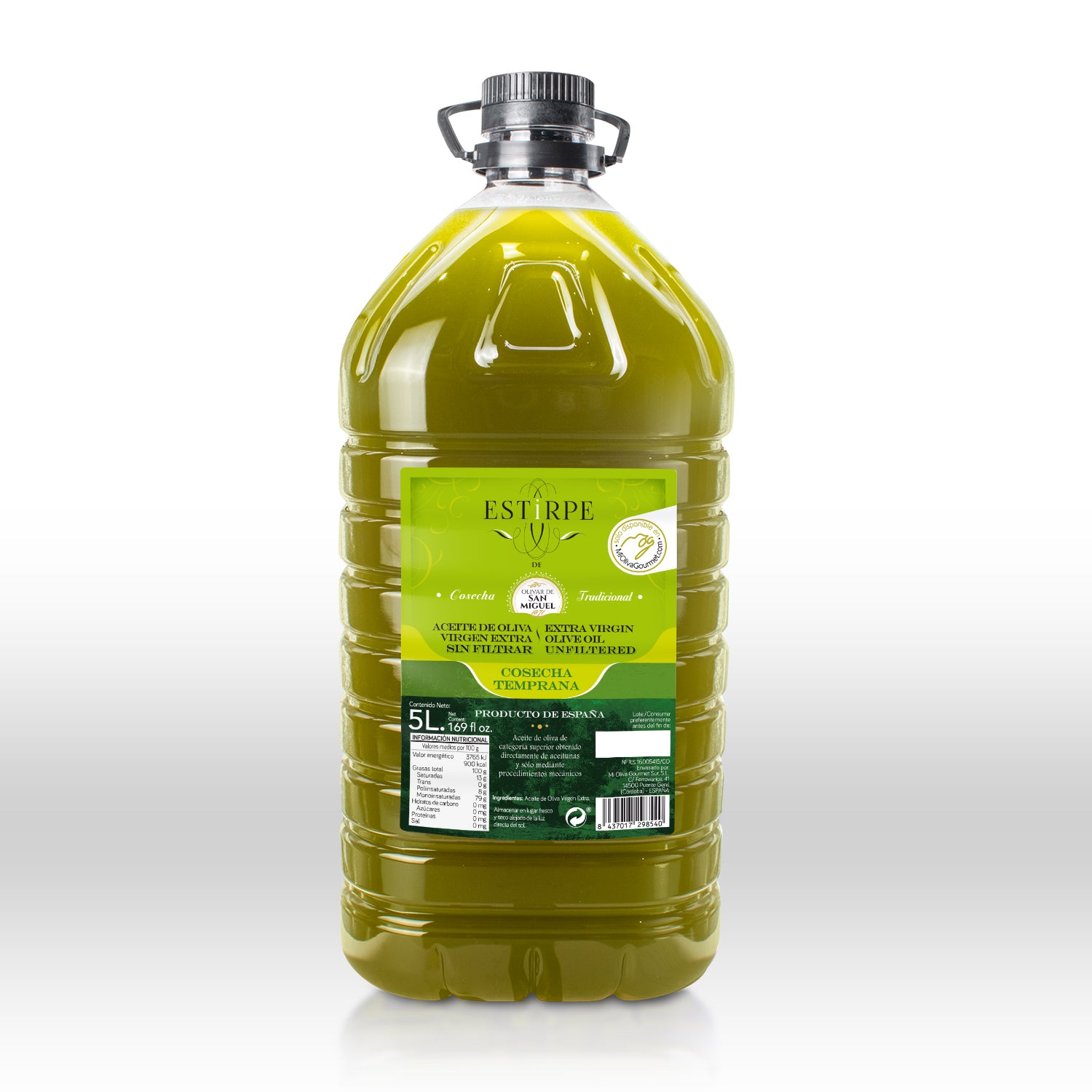
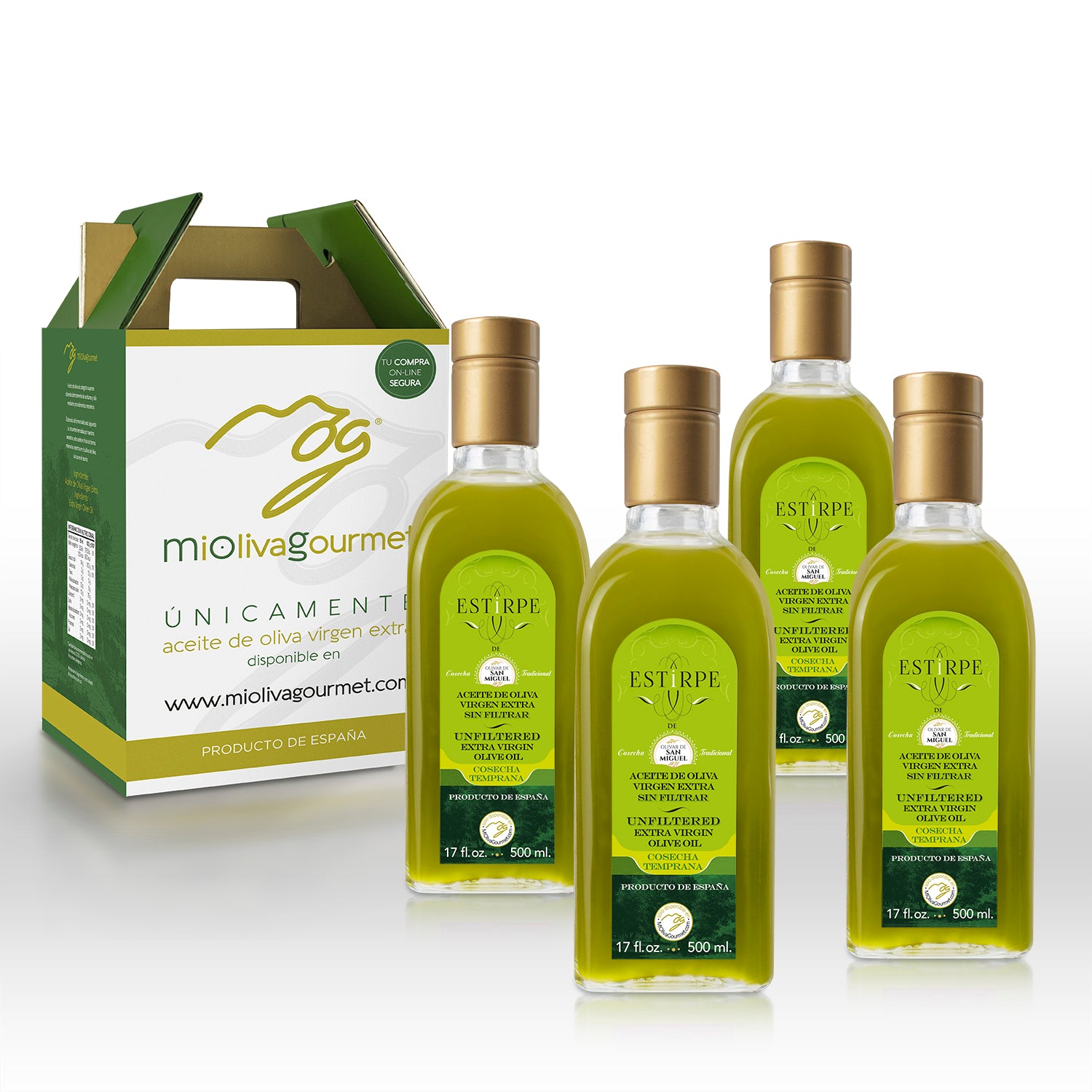
At Mi Oliva Gourmet, you can run all five checks without leaving this website: unfiltered extra virgin from a named estate (the Olivar de San Miguel grove in Puente Genil, Córdoba), oil that’s always from the latest harvest (we bottle daily and never carry anything over from one year to the next), declared varieties and measured polyphenols. And behind it all, a family that stands by what it makes.
Migue is the fourth generation of his family to tend these olive trees, some of them more than 200 years old. Every season’s olives are harvested and milled under real names: his and ours. And we bottle daily: the oil waits in tanks, protected from light, and leaves for your home in a closed, opaque box. Our EVOO never carries over from one season to the next. What you receive is always from the latest harvest.

The numbers this article has taught you to look for are published right here: 0.20° acidity in our Arraigo and our Estirpe Picual (against a legal maximum of 0.8°), over 250 PPM of polyphenols in both, and over 750 PPM in Prima Mensa, our most exclusive oil, with just 200 liters produced each year. All of them unfiltered, so the oil reaches your table exactly as it leaves the mill.
But rather than hearing it from us, hear it from verified buyers who made the switch from their usual oil. We love rereading these reviews:
★★★★★
“Spectacular. Flavor, aroma… it has it all. That peppery finish at the back of the throat is so pleasant. I’d compare it to acorn-fed Ibérico ham: when you swallow it and close your eyes… all your senses wake up. Congratulations to the whole team. I’ll recommend it without a second thought.”
Maria Moreno — Madrid · Verified buyer · Estirpe unfiltered
★★★★★
“For years I tried to find an oil I really liked. After buying a few others, I never quite found what I was looking for. Luckily, after a few years of trying, I ‘found it.’ I love its color, its evolving flavor and the way it finishes with a slight peppery sting in the throat, the mark of genuine, pure oil. I’ll definitely be buying again.”
Antonio de la Flor Barbadilla — Jerez de la Frontera · Verified buyer · Estirpe unfiltered Early Harvest
★★★★★
“I found its flavor and quality excellent, far superior to the commercial oils you find in supermarkets, and it’s truly worth paying a little more for an oil of this quality. At breakfast on a slice of bread, it’s spectacular.”
Manuel Colmenares — Valencia · Verified buyer · Arraigo Arbequino (limited harvest)
🎁 Your oil cruet, on us
Get our patented oil cruet free with your Prima Mensa using this code:
ACEITERA-GRATIS
Choose my oil with all the facts
Frequently asked questions
Is a “smooth” olive oil lower in quality?
It depends on the category. In plain “olive oil,” the smoothness comes from refining. In an extra virgin, “smooth” can describe a genuine varietal profile backed by tasting, an Arbequino, for example. The deciding words are still “extra virgin”; after that, you choose the intensity you like.
What does “first cold pressed” mean?
It’s a regulated term: it can only be used for oils obtained below 27 °C using traditional presses, a system that has almost disappeared today. Most modern mills extract by centrifugation, so the accurate wording you’ll see on current labels is “cold extraction,” also below 27 °C.
Does the color of the oil indicate its quality?
Color depends on the variety, the timing of the harvest and filtering. Official panels taste from blue glasses precisely so they aren’t swayed by it. A deep green and a pale gold can be equally excellent; why the color of extra virgin olive oil changes has its own article.
What is olive pomace oil?
It’s extracted with approved solvents from pomace (the solid residue left after pressing), then refined and blended with a share of virgin oil. It’s the cheapest category you’ll find at the supermarket, and it’s worth not confusing it with olive oil just because the word “olive” appears on the packaging.
Is filtered or unfiltered oil better?
Both can be excellent extra virgins. Unfiltered oil retains tiny olive particles that add body and flavor, and it’s meant to be enjoyed generously and sooner; filtered oil gains stability and keeps for more months. We explain the differences between filtered and unfiltered oil in depth.
How should I store olive oil at home?
Away from heat and direct light, tightly closed and, ideally, in dark glass, a tin or an opaque oil cruet. That’s why we designed our patented oil cruet: it preserves the oil’s properties as fully as possible between uses. The “best before” date marks a limit for the packaging; an oil is always at its best the closer it is to its harvest season.
Next time you’re standing in front of the olive oil shelf, turn the bottle around. Thirty seconds of reading are worth more than all the marketing on the front, and your oil cruet will notice the difference.
Warmly,
Julio
P.S. — If this article has cleared things up for you, forward it to the person at home who always buys “the usual one.” You’ll make it very easy for them.
P.P.S. — Not sure where to start? For people coming from supermarket oil, the one that surprises them most is Arraigo unfiltered: its 620 reviews, 96% of them 5-star, say it better than we can.
Julio César de la Vega Fernández, co-founder of Mi Oliva Gourmet together with Ricardo and Miguel Morales Chacón (Migue), fourth-generation olive growers in Puente Genil, Córdoba.




Leave a comment
This site is protected by hCaptcha and the hCaptcha Privacy Policy and Terms of Service apply.